
Environmental responsibility - Skarta

Environment

Environmental responsibility

Skarta Energy is a Finnish developer and producer of renewable energy. We specialise in emissions-free, industrial-scale solar power projects. Our goal is to facilitate the green transition by producing 800 MW of solar energy for Finland by the end of 2030. This is how we reduce dependence on fossil fuels, build the transition to a carbon neutral society and mitigate climate change. Our vision is to Make Finland a renewable energy superpower.

Climate impacts of solar power

Solar power plants produce fossil-free electricity from renewable solar energy. Like all energy production, solar energy has an environmental impact. The largest emissions from solar power plants arise from the acquisition of materials for the equipment used in photovoltaic systems, especially solar panels, and from the manufacture of equipment. A large proportion of solar panels are manufactured in China, which still uses a lot of energy produced from fossil fuels. However, emissions from solar power plants are compensated quickly, in just a few years, and thus their environmental impact remains minor in these respects. In addition, solar power plants have a long service life, up to forty years, and the required maintenance measures are minimal. It is typically calculated that in three years solar panels have produced enough fossil-free energy to compensate for the energy used in their manufacture.

Increasing the production of renewable electricity is essential if we want to reduce dependence on fossil fuels. Solar power is one of the lowest-emission, fastest and globally cheapest ways to increase the production of renewable electricity. Solar energy on an industrial-scale is also a key element in achieving Finland’s climate goals.
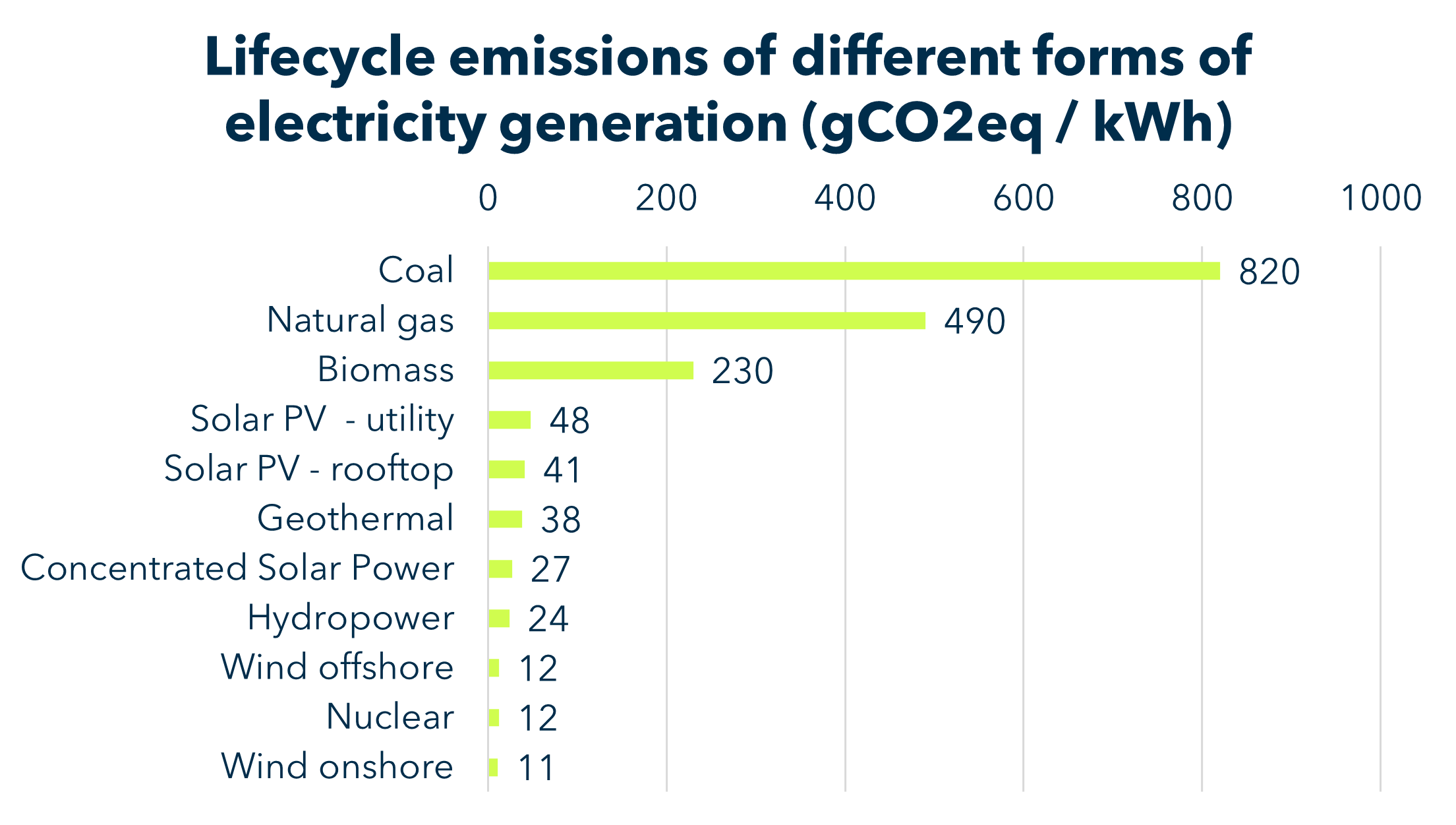
Lifecycle emissions of different forms of electricity generation.

Skarta Energy's greenhouse gas emissions

Calculating our greenhouse gas emissions is one of our most important indicators of environmental responsibility. We have been calculating greenhouse gas emissions of  our operations since 2022. In 2023, for the first time, we calculated not only Scope 1 and 2 emissions, but also our Scope 3 emissions.

In 2026, the SBTi has approved Skarta Energy’s near-term science-based emissions reduction target

Skarta's emission reduction targets

Skarta Energy commits to reduce absolute scope 1 and scope 2 GHG emissions 42% by 2030 from a 2024 base year, and to measure and reduce its scope 3 emissions.

Limiting the global temperature increase to 1.5°C requires action from all companies and industries worldwide. As a renewable energy producer, we want to lead by example through our commitment and inspire others working on climate action to do the same.

About the Science Based Targets initiative

The Science Based Targets initiative (SBTi) is a corporate climate action organization that enables companies and financial institutions worldwide to play their part in combating the climate crisis.

The SBTi develops standards, tools and guidance which allow companies to set greenhouse gas (GHG) emissions reductions targets in line with what is needed to keep global heating below catastrophic levels and reach net-zero by 2050 at latest.

The SBTi is incorporated as a charity, with a subsidiary which will host our target validation services. Their partners are CDP, the United Nations Global Compact, the We Mean Business Coalition, the World Resources Institute (WRI), and the World Wide Fund for Nature (WWF).

Environmental policy

The purpose of our environmental policy is to guide our operations taking into account our impacts on climate change, energy production and consumption, waterways, natural resources and biodiversity.

Read more about our Environmental Policy

Got interested?

Further information
Anna Korhonen
Anna Korhonen
HSEQ Manager